 Wael.T
 Compare ING Savings Maximiser and Ubank Save using 2026 bonus rates, balance caps, monthly conditions, welcome offers, FCS protection and compound-interest…
Australian savings rates are unusually attractive in 2026, but the highest advertised number often comes with a monthly test. ING Savings Maximiser can pay a higher rate on a smaller balance when several behavioural conditions are satisfied, while Ubank Save offers a slightly lower ongoing bonus rate across a much larger balance cap with a simpler growth rule. Add Ubank’s welcome offer and ING’s newly launched Savings Booster, and a headline-rate comparison becomes a conditions-and-cash-flow problem.
Why Australian savings comparisons are trending in 2026
The Reserve Bank of Australia left the cash rate target at 4.35% on August 11, 2026 after three increases earlier in the year, saying inflation remained too high and financial conditions had tightened. Higher policy rates have supported unusually competitive savings pricing. Banks are fighting for deposits with bonus-interest rules and introductory offers, which creates exactly the kind of high-intent search where the largest advertised percentage may not be the largest amount a customer actually receives.
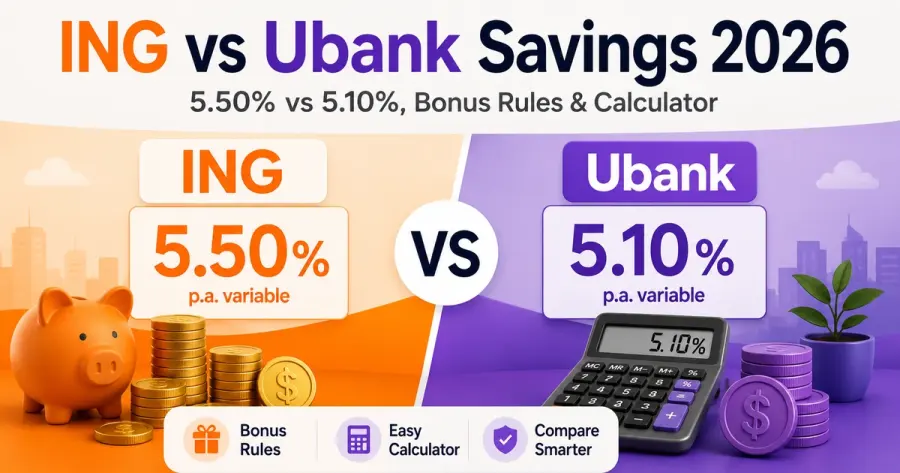
ING’s Savings Maximiser was increased to 5.50% p.a. for eligible customers from May 15, 2026. Ubank’s ongoing Everyday Bonus Rate became 5.10% p.a. from May 12, with bonus interest available on combined eligible Save balances up to $1 million when the monthly criteria are met. New Ubank customers may see a 5.85% Welcome Bonus Rate for up to four months. In August, ING also launched Savings Booster, offering eligible new-to-ING-savings customers up to 6.00% for the first four months on qualifying balances. Those products should be separated rather than blended into one permanent rate.
ING Savings Maximiser: the higher ongoing headline has more conditions
To earn ING Savings Maximiser’s additional variable rate, the customer must also hold an Orange Everyday account and complete several tasks during the current calendar month: deposit at least $1,000 from an external source to eligible ING products in their name, make at least five settled eligible card purchases, and grow the nominated Savings Maximiser balance compared with the prior month, excluding current-month interest. The additional rate then applies in the next calendar month.
The high rate is available on one nominated Savings Maximiser and on balances up to $100,000. This cap is crucial. A saver with $40,000 can reasonably compare 5.50% against Ubank’s 5.10%; someone with $300,000 cannot simply apply 5.50% to all $300,000. The Compound Interest Calculator should therefore split balances when a product’s interest cap is below the amount being compared.
Ubank Save: simpler monthly behaviour, much larger interest cap
Ubank’s current rule is conceptually simpler: you need a Spend account and must grow your combined Save balance by at least $1 during the month, excluding interest and special offset-account adjustments. If the criteria are met, the Everyday Bonus Rate is paid on combined eligible savings up to $1 million per customer. Ubank checks the growth condition at 11:30pm Sydney time on the final day of the month.
That simplicity has value for savers who do not want to manufacture five card transactions or redirect $1,000 of external income. However, the growth requirement still matters. If you withdraw $5,000 during the month, you must replace enough of it so that your eligible combined balance is at least $1 higher than the required prior benchmark, excluding the interest credit. A saver who routinely dips into savings can accidentally lose a month’s bonus despite the apparently easy rule.
The rate winner changes above $100,000
Below $100,000 and assuming all criteria are met, ING’s published 5.50% ongoing Savings Maximiser rate is 0.40 point above Ubank’s 5.10%. On $50,000, that gap is roughly $200 per year before tax and daily-balance effects. On $100,000, it is roughly $400. But the comparison changes immediately when the saver has more than $100,000 because ING’s high Savings Maximiser rate is capped at that balance.
Ubank’s Everyday Bonus Rate applies to eligible combined Save balances up to $1 million. A saver with $250,000 may therefore earn its ongoing bonus rate across far more money than the ING Savings Maximiser bonus can cover. The right analysis is not “5.50 is greater than 5.10”; it is “what rate applies to each dollar of my balance?”. This is a classic tiered-return calculation.
Monthly qualification risk should be priced like a fee
A bonus rate you fail to earn is economically similar to paying a very large hidden fee for that month. ING’s requirements involve three behavioural checkpoints plus the Orange Everyday relationship. Ubank has fewer conditions, but a net withdrawal can break its growth test. The saver should estimate not only the advertised rate but the probability of satisfying the rules every month.
Run a twelve-month “perfect compliance” scenario and then a realistic scenario in which you miss the bonus twice. If the fallback interest is much lower, those missed months can erase the advantage of the higher headline rate. This approach is more honest than assuming perfect behaviour simply because the conditions look easy when reading them once.
Ubank’s welcome rate is powerful but temporary
Ubank advertises a 5.85% p.a. Welcome Bonus Rate for eligible new customers for up to four months, after which the account can earn the ongoing Everyday Bonus Rate if its criteria are met. The welcome period is tied to when the customer joins Ubank, so opening another Save account later does not necessarily restart four months. Promotional eligibility and expiry should be checked in the app and current terms.
For a new customer with $80,000, four months at a higher welcome rate can outweigh ING’s ongoing advantage in the first year. But a correct calculation uses two stages: the welcome period and the post-welcome period. Never multiply 5.85% by twelve months unless the offer actually lasts a full year. Promotional rates are most valuable when their duration matches a short-term savings goal.
ING Savings Booster changes the new-customer conversation
ING launched Savings Booster in August 2026, making the comparison more interesting. Its campaign said customers new to ING savings could earn up to 6.00% p.a. variable on balances up to $500,000 for the first four months when they grow the account by at least $100 by month-end, with an active Orange Everyday account required. After the welcome period, the product uses its ongoing base and boost structure.
This means a new customer should not automatically compare only Savings Maximiser with Ubank Save. Savings Booster may be the more relevant ING product depending on eligibility, balance and planned behaviour. The article’s calculator can test all three paths: existing ING customer using Maximiser, new ING savings customer using Booster, and new or existing Ubank customer. The correct product can matter more than the bank name.
Growth conditions create a problem for withdrawals
Both products reward net saving, but they define the behaviour differently. ING requires the nominated Savings Maximiser balance to be higher than the previous month’s balance, excluding interest. Ubank requires combined Save balances to grow by at least $1 and explains that interest does not count. A large withdrawal near the end of the month can therefore jeopardize the bonus even if you made regular deposits earlier.
For a genuine emergency fund, that matters. The month in which you need $8,000 for a major repair is precisely the month you may fail the growth requirement. A saver should ask whether losing one month of bonus after an emergency is acceptable. The account still serves its primary purpose if the money was available; maximizing interest is secondary to having cash when needed.
Use a savings-goal workflow instead of chasing rate alone
Suppose you need a $60,000 home deposit in eighteen months and currently have $35,000. Use the Savings Goal Calculator to find the monthly contribution required under conservative interest assumptions. Then compare ING and Ubank. If the goal requires roughly $1,300 per month, you naturally satisfy ING’s $1,000 external-deposit condition if the transfer is structured correctly, and Ubank’s $1 growth rule is trivial—provided you do not make offsetting withdrawals.
For a saver adding only $100 per month, ING’s external-deposit requirement may require moving salary or money through eligible accounts even though the actual savings contribution is smaller. That operational step may be easy, but it is still a condition. The best account is one whose rules align naturally with your existing money flow rather than forcing transactions solely to earn interest.
Card-purchase requirements have a behavioural cost
ING’s five settled eligible card purchases can be effortless for someone who already uses Orange Everyday for groceries and transport. For a customer who prefers another bank’s credit card, however, the requirement creates a monthly checklist. There is no economic benefit in making unnecessary purchases merely to qualify. The purchases should be ordinary spending that would happen anyway.
The Budget Calculator is useful because it separates planned spending from qualification behaviour. If chasing bonus interest makes you spend $30 you would not otherwise spend, that can easily offset the annual interest advantage on a modest balance. Never manufacture consumption to earn a savings rate.
FCS protection: the $250,000 limit is per account holder per ADI
Australia’s Financial Claims Scheme protects eligible deposits up to $250,000 per account holder per authorised deposit-taking institution. The limit applies across accounts under the same banking licence, not simply per brand or account. ING states that combined eligible savings balances up to the government limit are covered. Ubank is part of NAB, and Ubank explicitly warns that a single guarantee applies across Ubank and other NAB deposits under the same banking licence.
This becomes important when comparing balances above $250,000. A Ubank customer who also holds large NAB deposits must aggregate them for the relevant FCS calculation. APRA’s Deposit Checker explains that different trading names under one banking licence do not create separate $250,000 guarantees. For large cash holdings, deposit-protection structure can outweigh a few tenths of a percentage point in interest.
Interest is assessable income for Australian residents
The Australian Taxation Office states that Australian residents generally need to declare interest from financial-institution accounts and term deposits as income. That means a 5.50% or 5.10% gross savings rate is not the same as the amount you keep after tax. The marginal effect differs by taxpayer and by ownership of joint accounts.
For planning, calculate gross interest first and then estimate tax separately rather than pretending the savings account is tax-free. If two spouses legitimately own savings jointly, the tax treatment depends on beneficial ownership and circumstances. Tax advice may be worthwhile for very large cash balances or unusual ownership structures.
Example: $80,000 and perfect monthly qualification
Imagine $80,000 held for twelve months and no withdrawals. If the published rates stayed unchanged and the saver qualified every month, ING Savings Maximiser’s 5.50% would start ahead of Ubank’s 5.10% ongoing rate. The gross difference is roughly $320 before exact daily compounding and tax. For an existing customer who naturally satisfies ING’s rules, that may be a meaningful advantage.
If the Ubank customer is new and receives the 5.85% welcome rate for four months, the first-year result changes. Model four months at the welcome rate and eight months at the ongoing rate. Depending on exact dates and rate changes, Ubank may narrow or reverse the first-year gap. This is why promotional periods need timeline math rather than annualized marketing comparisons.
Example: $300,000 changes the answer completely
Now imagine $300,000. ING Savings Maximiser’s high rate applies only to the eligible portion up to $100,000, so the remaining money needs another ING product or another institution to earn a competitive return. Ubank can apply its bonus rate across eligible combined Save balances up to $1 million, though FCS protection is still capped according to the government rules.
A sophisticated saver might split funds among multiple ADIs for deposit protection and rate optimization rather than keep the entire amount at one bank. At this balance, the decision becomes a portfolio of cash accounts: FCS limits, bonus caps, administration and tax all matter. A single-rate comparison is no longer adequate.
Example: a withdrawal month exposes the real rule
Suppose a Ubank saver begins the month with $40,000, earns interest, but withdraws $5,000 for a car and adds $1,000 later. The account may fail the growth criterion because the ending eligible savings are still below the required benchmark. At ING, a similar withdrawal can also prevent the nominated Savings Maximiser from growing compared with the prior month.
This is not necessarily a reason to avoid either account. It is a reason to understand the product. If savings exist to pay for a car, using them is success, not failure. The sensible comparison includes a “withdrawal year” scenario where one or two bonus months are missed so the forecast resembles real household cash flow.
Who is likely to prefer ING, and who is likely to prefer Ubank?
ING Savings Maximiser may fit savers with balances at or below $100,000 who already use Orange Everyday, can naturally meet the $1,000 deposit and five-card-purchase requirements, and expect their nominated balance to grow each month. Ubank may fit people who want a much larger bonus-interest cap and prefer a simpler monthly rule, especially if they already want its Spend/Save ecosystem.
New customers should separately compare Ubank’s Welcome Bonus and ING Savings Booster, because the promotional product can dominate the first four months. Verify live rates, eligibility and caps immediately before opening or moving money. Australia’s savings market is changing rapidly with RBA policy and bank competition.
Bottom line: the best rate is the rate you actually qualify for
ING’s Savings Maximiser has the higher published ongoing bonus rate in the snapshot used here, but its $100,000 cap and multi-step monthly conditions matter. Ubank’s 5.10% ongoing bonus is lower but applies across a much larger eligible balance and uses a simpler growth test. New-customer promotions can temporarily reverse either ranking.
Use the embedded calculator with your real balance and a month-by-month eligibility assumption. Add a scenario where you miss bonus interest, and check FCS exposure before optimizing large balances. This article is educational information, not personal financial or tax advice, and variable rates and conditions can change.
Compare ING Savings Maximiser and Ubank Save with the Compound Interest Calculator
Sources / Official references
- Reserve Bank of Australia — 11 August 2026 monetary policy decision
- ING Australia — Savings Maximiser rate announcement
- ING Australia — Savings Maximiser
- ING Australia — Savings Booster launch, August 2026
- Ubank — High Interest Savings Account
- Ubank — Bonus interest rules
- APRA — Financial Claims Scheme deposit checker
- Australian Taxation Office — Interest income