 Wael.T
 A deep 2026 Singapore CPF guide covering contribution rates, the S$8,000 Ordinary Wage ceiling, CPF interest, BRS/FRS/ERS, housing refunds, top-ups, CPF LIFE…
Updated: 26 August 2026
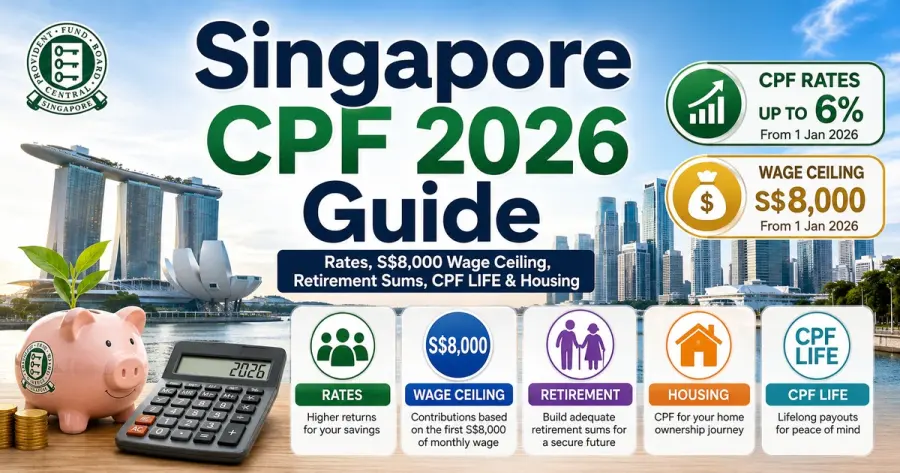
CPF is not just a retirement account. It is a compulsory savings system that connects employment income, housing, healthcare and retirement income, so a decision in one part can affect another years later. In 2026, the Ordinary Wage ceiling has reached S$8,000 per month, contribution rates for workers above 55 to 65 are higher than in 2025, and the government has already announced another increase for some senior workers from January 2027. For members turning 55 in 2026, the Basic Retirement Sum is S$110,200, the Full Retirement Sum is S$220,400 and the Enhanced Retirement Sum is S$440,800. Understanding how these pieces interact is more useful than looking at a single CPF balance.
1. Start with the 2026 employee contribution rates
For Singapore Citizens and third-year-and-later Permanent Residents earning monthly wages above S$750, the total CPF contribution rate in 2026 is 37% for employees aged 55 and below: 17% from the employer and 20% from the employee. For ages above 55 to 60, the total is 34%; above 60 to 65 it is 25%; above 65 to 70 it is 16.5%; and above 70 it is 12.5%. The detailed treatment differs for lower wage bands and first- or second-year Permanent Residents. The important planning point is that age changes both take-home pay and the amount flowing into CPF, so a birthday near a band boundary can change cash flow as well as retirement accumulation.
2. Another senior-worker increase is already scheduled for January 2027
CPF Board has announced that from 1 January 2027, contribution rates will rise again for employees aged above 55 to 65. The total rate for those above 55 to 60 is scheduled to increase from 34% to 35.5%, while the rate for those above 60 to 65 rises from 25% to 26%. The increase is directed to the Retirement Account up to the Full Retirement Sum, with specified rules if the FRS has already been set aside. A worker approaching these ages should therefore build a 2027 budget with the new employee contribution component rather than assuming 2026 take-home pay will remain unchanged.
3. The Ordinary Wage ceiling is S$8,000 a month in 2026
The CPF Ordinary Wage ceiling reached S$8,000 on 1 January 2026 after several staged increases. This means an employee earning S$9,500 of Ordinary Wages in a month does not pay CPF on the full S$9,500 as Ordinary Wages; the monthly amount subject to CPF is capped at S$8,000, subject to the rules. The annual salary ceiling remains S$102,000, and Additional Wages such as bonuses use a separate ceiling formula. For higher earners, the increase from the 2025 monthly ceiling of S$7,400 to S$8,000 raises both employee deductions and employer contributions during the year.
4. Bonuses are governed by the Additional Wage ceiling
Additional Wages are not simply treated as another monthly salary. CPF Board calculates the Additional Wage ceiling as S$102,000 minus the total Ordinary Wages already subject to CPF for the year, on a per-employee, per-employer basis. This matters for people with large performance bonuses. A worker receiving a high bonus after twelve months at the S$8,000 Ordinary Wage ceiling will have far less Additional Wage room than someone with a lower base salary. If you are estimating annual take-home compensation, use the Hourly to Salary and Paycheck Calculator for the cash side, but verify CPF payroll treatment against CPF Board rules.
5. CPF contributions do not all go into the same account
Before age 55, CPF savings are allocated among the Ordinary Account, Special Account and MediSave Account according to age-related allocation rules. At age 55, a Retirement Account is created and the Special Account is closed under the current structure, with retirement savings reorganised according to the rules. OA is commonly associated with housing and shorter-horizon approved uses; MediSave is for healthcare needs; retirement balances are designed for future income. Looking only at “total CPF” can therefore be misleading. Two members with the same total balance but very different OA, MA and RA amounts may have very different housing flexibility and retirement readiness.
6. CPF interest in the third quarter of 2026 is 2.5% for OA and 4% for SMRA
For 1 July to 30 September 2026, CPF Board published an Ordinary Account rate of 2.5% per year and 4% for Special, MediSave and Retirement Account savings. The OA rate is reviewed quarterly using a bank-rate formula subject to a legislated 2.5% floor. SMRA rates are linked to a government-securities formula plus 1%, subject to a 4% floor that has been extended through the end of 2026. These are not promotional bank rates; they are part of the CPF framework. For long-term projections, use current rates as inputs, not permanent promises, because future quarterly and policy settings can change.
7. Extra interest makes the first portion of CPF balances more valuable
CPF also pays extra interest on qualifying first balances. Members below 55 can receive an extra 1% per year on the first S$60,000 of combined balances, with up to S$20,000 from OA included in that calculation. Members aged 55 and above can receive an extra 2% on the first S$30,000 and an extra 1% on the next S$30,000, again subject to the OA cap in the combined-balance rule. The extra interest on OA is channelled toward retirement savings. This structure means the effective return on the first dollars of CPF can differ from the headline base rate shown for the account.
8. Compound interest is powerful because CPF is a long-duration system
A 4% annual rate sustained for many years can materially change retirement balances because interest itself earns future interest. Use the Compound Interest Calculator to see the difference between ten, twenty and thirty years of compounding. The lesson is not that 4% will remain unchanged forever; it is that withdrawing or redirecting retirement money early has an opportunity cost. When OA is used for housing, for example, the member gives up the interest that those CPF savings could otherwise have earned.
9. The 2026 retirement sums are reference points, not personal spending budgets
For members turning 55 in 2026, CPF Board lists a Basic Retirement Sum of S$110,200 and a Full Retirement Sum of S$220,400. The current 2026 Enhanced Retirement Sum is S$440,800. These amounts are used within the retirement framework and help determine how much can be set aside in the Retirement Account. They should not be confused with a statement that every household can live comfortably on a particular amount. Housing status, healthcare, family support, inflation and desired lifestyle can make retirement spending much higher or lower than another member’s.
10. CPF Board’s payout illustrations are useful, but they are estimates
For someone turning 55 in 2026, CPF Board illustrates estimated monthly CPF LIFE Standard Plan payouts from age 65 of about S$950 at the BRS, S$1,780 at the FRS and S$3,440 at the ERS, subject to its assumptions. The actual payout depends on retirement savings, age when payouts start, plan selection and future parameters. Use these numbers as planning anchors rather than guarantees. The Retirement Calculator can combine an estimated CPF LIFE income with other income such as investments, rental income or employment to identify a household retirement gap.
11. CPF LIFE can start anytime from age 65 to 70
For members at the relevant payout eligibility age, CPF LIFE payouts can generally begin between ages 65 and 70. CPF Board states that deferring can increase monthly payouts by up to 7% for each year of delay, and payouts automatically start at age 70 if the member has not instructed otherwise. Deferral is not automatically the better choice. A member who needs cash at 65 may value immediate income more than a larger future payment; another member still working with ample liquid assets may prefer to defer. The decision should be based on current cash flow, health, other lifelong income and desired spending.
12. Do not confuse CPF payout age with Singapore’s retirement age
Singapore’s employment retirement and re-employment ages are separate from CPF payout eligibility. The retirement age rises to 64 and the re-employment age to 69 from 1 July 2026, while CPF LIFE payout eligibility remains from age 65 under the current rules. A person can therefore still be working when eligible to start CPF LIFE, or can retire from a job before taking payouts. This separation matters when building a retirement timeline. The correct model should include employment income by age, CPF contribution changes, the chosen CPF LIFE start date and other savings rather than using one single “retirement age.”
13. Using OA for housing creates an invisible retirement trade-off
CPF is designed to help with home ownership as well as retirement, so using OA for a property is a legitimate feature of the system. But every dollar used for housing is a dollar that is not remaining in OA to earn CPF interest. The benefit is lower cash outflow for the home; the cost is less CPF compounding. This trade-off becomes especially important for households that use a large part of OA for mortgage payments over many years. Use the Mortgage Calculator to compare a larger cash payment with heavier OA use and see how much monthly cash flow changes.
14. Selling a home can trigger a CPF refund of principal plus accrued interest
When CPF savings have been used for property, selling the property generally requires refunding the CPF principal amount used plus accrued interest, subject to the detailed rules and sale-proceeds limits. For members aged 55 or above, housing refunds may first be used to top up the Retirement Account toward the required retirement sum before excess amounts remain in OA. This does not mean accrued interest is a bank penalty; it represents the interest the CPF savings would have earned if they had stayed in the account. Homeowners should check their Home ownership dashboard before estimating how much cash they will receive from a future sale.
15. A voluntary housing refund can be a retirement decision
CPF Board allows eligible members to make a voluntary housing refund before selling the property. Doing so can restore money to CPF earlier, reduce the refund required at sale and allow the refunded amount to resume earning CPF interest. The trade-off is liquidity: cash paid back to CPF is no longer available for other household uses in the same way as cash in a bank account. A homeowner with a weak emergency fund should not automatically prioritise a voluntary refund. Compare the guaranteed CPF interest benefit with the value of maintaining sufficient accessible cash.
16. Cash top-ups and transfers can increase retirement income, but some moves are irreversible
CPF allows several forms of top-up or transfer subject to eligibility and limits. CPF Board notes that eligible cash top-ups to oneself can receive tax relief of up to S$8,000 per year, with an additional S$8,000 possible for eligible family top-ups, subject to conditions. Transferring excess OA to Special Account or Retirement Account can increase the amount earning the higher retirement-account rate, but CPF transfers can be irreversible. Before moving OA, protect future housing needs and liquidity. A higher interest rate is attractive only if the money can genuinely remain dedicated to retirement.
17. The CPF Annual Limit is S$37,740
The current CPF Annual Limit is S$37,740 and includes mandatory and relevant voluntary contributions to an employee’s CPF accounts during the calendar year. A person considering voluntary contributions to all three accounts must subtract expected mandatory CPF contributions from that limit. Excess voluntary contributions can be refunded without interest. Higher-income employees may already be close to the annual limit through salary and bonus contributions, so an end-of-year top-up should not be made without checking year-to-date contributions.
18. Example: age 40, monthly salary S$8,500, buying a larger home
An employee aged 40 earning S$8,500 of monthly Ordinary Wages is subject to CPF contributions on up to the S$8,000 OW ceiling, not the entire S$8,500 as Ordinary Wages. If the household is considering a bigger property, the question is not simply “how much OA can we use?” It is how heavier OA usage affects retirement compounding, cash mortgage payments and emergency liquidity. Use the Home Affordability Calculator alongside CPF housing rules so the property budget does not depend on draining every available housing dollar.
19. Example: age 58 and still working
A 58-year-old in 2026 falls in the above-55-to-60 contribution band, where total CPF contributions are 34% for monthly wages above S$750 under the standard citizen/third-year PR table. From January 2027, that band is scheduled to rise to 35.5%, with the increase directed toward retirement savings up to the FRS. This person should model both lower take-home pay and stronger CPF accumulation in 2027. If housing payments are still large, the interaction between OA balance, RA funding and disposable cash becomes more important than simply celebrating the higher contribution rate.
20. Example: age 65 deciding whether to start CPF LIFE
A member reaching 65 with adequate cash savings and continuing employment may consider deferring CPF LIFE because monthly payouts can rise with delay. A member who has retired, has little cash outside CPF and needs stable monthly income may prefer to start sooner. Neither decision is universally superior. Use a retirement budget that lists essential expenses, other income, medical reserves and desired discretionary spending. The Budget Calculator can clarify whether deferral is financially comfortable or would force the household to spend down emergency assets too quickly.
21. A practical CPF review checklist for 2026
Check your age-based contribution rate, Ordinary Wage and Additional Wage treatment, year-to-date CPF contributions, OA use for housing, required housing refund, MediSave needs, Retirement Account progress and the current BRS/FRS/ERS relevant to your cohort. If you are nearing 55, understand the account changes; if nearing 65, compare CPF LIFE start dates; if still accumulating, review whether voluntary top-ups are appropriate after protecting cash needs. CPF works best when housing, healthcare and retirement are planned together rather than as three separate financial projects.
Bottom line
CPF in 2026 is a moving system: the S$8,000 Ordinary Wage ceiling is now fully in place, senior-worker contribution rates rose this year and another increase for ages above 55 to 65 is already scheduled for 2027. Interest floors, retirement sums, CPF LIFE, housing refunds and top-up rules all interact. The best strategy is not simply to maximise every possible contribution. It is to preserve enough cash for present needs while allowing retirement balances to compound for the future. This article is general educational information, not personalised retirement, tax, housing or financial advice.
Official and authoritative sources
- CPF Board — CPF overview and 2026 contribution rates
- CPF Board — Current CPF contribution rates for senior workers
- CPF Board — Contribution changes from 1 January 2027
- CPF Board — Ordinary Wage ceiling reaches S$8,000 in 2026
- CPF Board — CPF interest rates for July to September 2026
- CPF Board — 2026 retirement sums and reference payouts
- CPF Board — CPF LIFE payout age and deferral
- CPF Board — CPF refund when selling property
- CPF Board — CPF Annual Limit
- CPF Board — Cash top-ups and compound interest