 Wael.T
 Compare Trading 212 and Vanguard Investor UK Stocks & Shares ISAs by 2026 platform fees, ETF choice, FX, fractional shares, dealing, transfers, FSCS and…
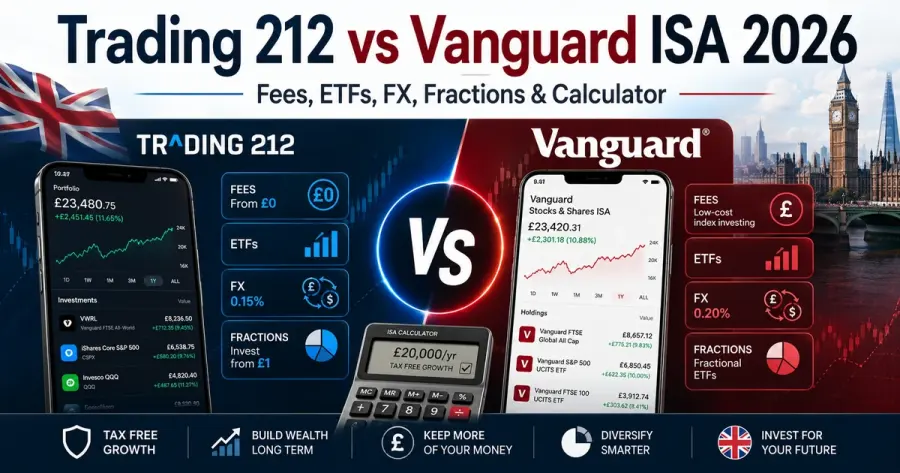
Trading 212 and Vanguard Investor UK can both hold investments inside a Stocks & Shares ISA, but they solve very different problems. Trading 212 offers a broad stock-and-ETF marketplace with £0 trading commission, no custody fee and a 0.15% FX fee when currency conversion is required. Vanguard Investor is a curated Vanguard-only platform with an account fee, more limited choice and a deliberately simpler passive-investing experience. The right comparison therefore starts with the portfolio you want to own, not with the app that looks cheapest.
Why this comparison matters more as the ISA rules evolve
The UK ISA allowance remains £20,000 for the 2026–27 tax year. Money invested inside a Stocks & Shares ISA can grow without UK income tax or capital gains tax on qualifying investments, subject to ISA rules. From 6 April 2027, the government plans to cap new Cash ISA subscriptions at £12,000 for people under 65 while keeping the overall ISA allowance at £20,000. That does not force anyone into shares, but it increases interest in how a Stocks & Shares ISA works and what platform costs matter.
Trading 212 and Vanguard Investor sit at opposite ends of the DIY spectrum. Trading 212 gives access to a much broader selection of individual shares and ETFs, including fractional investing. Vanguard Investor limits the self-managed service to Vanguard funds and ETFs, which can make portfolio construction less distracting. One platform maximizes choice and minimizes explicit dealing fees; the other deliberately narrows the menu and charges for the service.
Start with the investment plan, not the ISA provider
An ISA is a tax wrapper, not an investment. The return comes from what you hold inside it. A 100% global equity ETF can fall heavily in a bad market whether it sits at Trading 212 or Vanguard. A cautious investor with a three-year goal may need a different asset mix from a 28-year-old saving for retirement over 35 years.
Use the Investment Calculator to model the goal before comparing platforms. Enter starting capital, monthly contributions, time horizon and several return assumptions. Then choose an asset allocation that you could realistically hold through market declines. Platform optimization should happen after risk and horizon are defined.
Trading 212: £0 dealing commission is only one part of the cost
Trading 212 currently lists trading commission as free and custody fee as free for its Invest, ISA and SIPP services. The main platform-specific cost that often matters to a UK investor is its 0.15% FX fee when a trade requires currency conversion. UK stamp taxes or exchange-specific charges can still apply in relevant cases, and every ETF or fund has its own ongoing cost within the product.
That structure can be extremely cheap for an investor buying UK-traded ETFs in sterling. If the ETF itself has a 0.20% annual ongoing charge and the platform takes no custody fee, the fund cost may dominate. But a portfolio that buys US shares in dollars every week creates a different cost profile because FX is triggered repeatedly.
Vanguard Investor: the account fee creates a visible minimum cost
Vanguard Investor's self-managed Stocks & Shares ISA currently charges £4 per month when the invested balance is below £32,000. At £32,000 and above, the account fee is 0.15% a year, capped at £375 annually. Investors also pay the ongoing costs of the Vanguard funds they own, with Vanguard publishing a range that varies by product.
For a £5,000 beginner, £48 a year is equivalent to 0.96% of the portfolio before the fund's own cost. At £20,000 it is 0.24%; near £32,000 the fee transitions to the percentage structure. This does not automatically make Vanguard poor value, because the investor may value simplicity and service, but the fixed £48 matters much more at small balances than at larger ones.
The break-even effect of Vanguard's £4 monthly fee
Suppose two investors hold an identical Vanguard ETF available on both platforms and make no foreign-currency trades. Trading 212's platform and dealing charges for that holding may be zero, while Vanguard Investor charges £48 a year below £32,000. On a £4,000 account, the £48 is 1.2% of the balance. On £24,000, it is 0.2%. The same nominal fee therefore has very different long-term significance.
Use the Compound Interest Calculator to model £48 per year not invested for 20 or 30 years. The effect is modest once the portfolio is large, but meaningful for a beginner. Cost comparisons should always translate pounds into a percentage of the account.
Trading 212 offers far more investment choice
Trading 212 provides access to thousands of shares and ETFs across multiple markets. An investor can build a portfolio from a global ETF, UK gilt ETF, emerging-markets ETF, sector funds and individual companies. Fractional shares make it possible to invest small pound amounts in eligible securities instead of buying a whole share.
Choice is useful when it serves a plan. It can also create behavioural risk. A long-term ISA can turn into a collection of technology themes, meme stocks and overlapping ETFs because the app makes switching easy. Zero commission reduces trading friction, which is financially beneficial for disciplined investors but can encourage unnecessary activity in less disciplined ones.
Vanguard's limited menu can be a behavioural advantage
Vanguard Investor's self-managed platform offers more than 85 Vanguard funds according to its current guidance, rather than a whole-market brokerage catalogue. The range includes broad index funds, ETFs, bond funds and multi-asset LifeStrategy-style options. Investors cannot use the Vanguard platform to buy an individual Tesco, Nvidia or Barclays share.
That restriction can be a feature for someone who wants a simple passive plan. A saver can choose one diversified fund and automate contributions without a constant stream of new securities to chase. The disadvantage is equally clear: if your desired portfolio contains a non-Vanguard ETF or individual shares, Vanguard Investor cannot hold it.
Fractional investing changes the experience for small monthly contributions
Trading 212 supports fractional investing for many eligible instruments, with some purchases possible from very small amounts. This matters when the price of one full share exceeds the monthly contribution. A £50 monthly investor can still allocate nearly all the money rather than waiting several months to buy one whole share.
Vanguard's traditional fund structure can also accommodate regular contributions without requiring whole ETF units in the same way when using mutual-fund style products, while ETF dealing has its own execution process. The practical question is whether your chosen investment lets each contribution reach the market efficiently.
FX at Trading 212 matters mainly when the security trades in another currency
Trading 212 charges 0.15% FX on applicable conversions. If you invest £1,000 into a US-dollar security, 0.15% is about £1.50 per conversion before considering market spread. Twelve £1,000 conversions would therefore represent roughly £18 in explicit FX fees. That is still lower than many traditional retail brokerage FX charges, but it is not zero.
Buying a sterling-traded ETF that internally holds US companies is different from buying a US-listed security directly. The fund may have currency exposure to the dollar without the investor personally paying a brokerage FX conversion on each purchase. Currency exposure and currency conversion fee are separate concepts.
Multi-currency capability differs between Trading 212 Invest and ISA
Trading 212 promotes multi-currency functionality for its Invest account, but ISA operations remain constrained by ISA structure and sterling funding rules. Do not assume every multi-currency feature advertised for the general investing account applies identically inside the ISA. Check the live help documentation for the specific ISA transaction you intend to make.
For a UK investor mainly buying London-listed ETFs in sterling, this may be irrelevant. For someone frequently trading US individual stocks inside the ISA, it affects how often 0.15% FX is incurred.
Vanguard ETF dealing: free batch service versus £7.50 live dealing
Vanguard Investor offers free batch dealing for ETFs at scheduled dealing points, currently twice per business day according to its guidance. Investors who want an immediate live ETF quote can use Quote and Deal, which carries a £7.50 fee per trade. Mutual fund orders follow their own valuation and dealing process.
A long-term investor making monthly ETF contributions may have no need to pay £7.50 for live execution. Someone who insists on a precise intraday price can incur costs that dramatically change the platform comparison. The execution method should match the investment strategy.
Example: £100 per month from a new investor
Consider a beginner with no starting balance and £100 monthly contributions. During the first year the average invested balance is small. Vanguard's £48 annual platform fee represents a high percentage of those early assets, while Trading 212's explicit platform charge can be zero if the investor buys a sterling ETF and avoids FX.
The result does not mean the investor should select Trading 212 automatically. If Vanguard's limited menu prevents speculative trading and keeps the saver contributing for 20 years, behavioural value can exceed £48. But the investor should consciously know what the simplicity costs.
Example: a full £20,000 annual ISA contribution
An investor who contributes the entire £20,000 annual allowance and invests in one global equity fund has a different cost profile. £48 is only 0.24% of £20,000 in the first simple comparison, while Trading 212 can still have no custody fee. Over time, if the Vanguard balance crosses £32,000, the fee becomes 0.15% rather than the flat £4 monthly amount.
At that point, fund choice may matter more. If the same Vanguard ETF can be held on Trading 212, the investor can isolate the platform fee by using identical fund assumptions in the calculator. If different funds are selected, differences in benchmark, OCF and tracking must be included too.
Example: £75,000 ISA built over several years
At £75,000, Vanguard's 0.15% account fee is £112.50 per year before fund costs. Trading 212's custody/platform fee remains zero under its current fee schedule, but a portfolio of foreign-currency shares may incur FX with each transaction. A sterling ETF buy-and-hold investor would therefore see a clearer direct fee advantage at Trading 212 than an active US-stock investor.
Do not switch purely to save £112.50 without reviewing transfer mechanics and holdings. The annual saving must be weighed against administrative effort, unsupported securities and whether the target platform genuinely suits the strategy.
ISA transfers should preserve the tax wrapper
Trading 212 supports ISA transfers and states that a correctly executed ISA transfer does not count as a fresh contribution against the annual allowance. It supports cash and in-specie transfers in applicable cases. Fractional positions cannot generally transfer between providers and may need to be sold or handled separately.
Do not withdraw the ISA to a personal bank account and then redeposit simply to change provider unless you fully understand the flexible-ISA rules and contribution consequences. Use the formal transfer process when preserving the tax wrapper is the goal.
In-specie transfer can reduce time out of market
An in-specie transfer moves supported holdings without selling them first. That can reduce the risk that markets rise while the investor is temporarily in cash. It can also avoid unnecessary dealing, although transfers can take time and the receiving platform must support the exact security.
Moving from Vanguard Investor to Trading 212 may be straightforward for a Vanguard ETF that Trading 212 supports, but a Vanguard mutual fund not traded on exchange may require different treatment. Check security eligibility before initiating the transfer.
Moving from Trading 212 to Vanguard can be much more restrictive
Because Vanguard Investor only supports Vanguard products, a Trading 212 portfolio containing individual shares or non-Vanguard ETFs cannot simply be replicated there. Assets may need to be sold, transferred elsewhere or retained outside Vanguard. That makes the platform's limited investment universe particularly important before initiating a transfer.
A saver who expects to hold multiple fund providers should not choose Vanguard Investor merely because of the brand's reputation for passive investing. The wrapper and the investment shelf are separate decisions.
FSCS protection does not protect your portfolio from falling
Eligible investment claims can be protected by the Financial Services Compensation Scheme up to £85,000 per eligible person per firm in relevant circumstances, such as certain failures where protected assets are missing. FSCS does not compensate ordinary investment losses. If a global equity fund falls 25% because markets decline, that is investment risk.
Trading 212 UK Ltd is FCA regulated, and Vanguard's UK investment service operates within the UK regulatory framework. High-balance investors should read the current custody and FSCS arrangements rather than interpreting £85,000 as a guarantee of portfolio market value.
Individual shares increase concentration risk regardless of platform fee
Trading 212 makes it possible to build a portfolio of individual companies at no dealing commission. That can be useful for informed investors, but owning ten favourite shares is not automatically diversified. Company-specific failures can permanently destroy capital.
Vanguard's fund-only environment naturally pushes users toward pooled investments. If you use Trading 212, you can recreate the same broad diversification by choosing diversified ETFs and resisting the temptation to treat the ISA as a trading account.
Pies and automation can help, but rebalancing can also trigger unnecessary trading
Trading 212's portfolio features can automate target allocations and recurring purchases. For a simple three-ETF portfolio this can make contributions efficient. However, frequent rebalancing to tiny target differences can create more FX or trading activity than necessary, even where commissions are zero.
A long-term investor can often rebalance using new contributions rather than selling. This reduces turnover and keeps the process focused on asset allocation rather than daily market movement.
Vanguard managed service should not be mixed into the DIY comparison
Vanguard also offers managed investment services with additional management costs. Those services select and maintain a portfolio for the investor. They should not be placed in the same fee comparison as Trading 212 self-directed investing or Vanguard's self-managed ISA.
If you want advice-like portfolio management, compare managed services with other managed or robo-adviser offerings. If you want to select your own ETF, compare DIY platforms. Paying for management is a different purchase from paying for custody.
Retirement investors should compare contribution discipline before platform sophistication
A 30-year-old investing £300 every month for 35 years is likely to be affected far more by contribution consistency, market returns and asset allocation than by a small difference in interface. Use the Retirement Calculator to estimate the contribution required for the long-term target.
Then choose the ISA platform that supports that plan with the least costly friction. If a broad global ETF and automatic monthly investment are all you need, additional trading features may have no financial value.
Do not confuse a Stocks & Shares ISA with a savings account
The word ISA appears in both Cash ISA and Stocks & Shares ISA, but the risk is very different. Cash preserves nominal value subject to bank terms and deposit protection; investments fluctuate and can be worth less when sold. The 2027 Cash ISA rule change should not push someone with a short horizon into market risk simply to use the remaining overall allowance.
Money for an emergency fund or a property purchase next year generally needs a different risk treatment from retirement money. The tax wrapper never overrides the goal.
What to verify immediately before opening an ISA
Confirm the current platform fee, dealing fee, FX rate, supported investments, minimum contribution, fractional-share rules, transfer procedures, recurring-investment features, account protection, ETF/fund ongoing costs and whether the platform supports the exact assets you want. Fee pages can change, so verify the live terms before funding the account.
Also track your total ISA subscriptions across all providers. The £20,000 allowance is shared, not £20,000 per app. A platform cannot reliably know what you paid into another provider earlier in the tax year.
Bottom line: Trading 212 is cheaper and broader; Vanguard Investor is narrower and intentionally simpler
For a self-directed investor who wants broad market access, fractional investing and minimal explicit platform charges, Trading 212 has a strong cost and flexibility case. Vanguard Investor charges a visible account fee and restricts the investor to Vanguard products, but that simplicity can appeal to someone who wants a deliberately limited passive-investing environment and has no need for individual stocks or third-party ETFs.
Use the Investment Calculator below with the same underlying portfolio assumptions and each platform's recurring fees. The platform is important, but the asset allocation, savings rate and ability to stay invested are usually more important. This article is general educational information, not personal investment or tax advice.
Compare Trading 212 and Vanguard Investor fees with the Investment Calculator
Sources / Official references
- Trading 212 — Invest, ISA and SIPP fees
- Trading 212 — Stocks & Shares ISA
- Trading 212 — Portfolio transfers
- Trading 212 — ISA transfers
- Trading 212 — Fractional investing
- Vanguard Investor UK — Stocks & Shares ISA
- Vanguard Investor UK — Fees explained
- Vanguard Investor UK — How to start investing
- Vanguard Investor UK — Order placement and ETF dealing
- GOV.UK — ISA reform from April 2027
- FSCS — Investment protection