 Wael.T
 Compare EQ Bank and Tangerine savings accounts using current rates, promotional periods, direct-deposit conditions, liquidity, TFSA options and CDIC protection.
Canadian savers comparing EQ Bank and Tangerine in 2026 face a classic problem: a promotional rate can be much higher than an ongoing rate, but only for a limited period and only if eligibility conditions are met. EQ Bank, meanwhile, offers different rates depending on account type, notice period and direct-deposit qualification. A useful comparison therefore needs a timeline, not just one APY number.
Why high-interest savings comparisons are especially relevant in Canada in 2026
The Bank of Canada held its policy interest rate at 2.25% in July 2026, after a series of reductions in 2025. That environment has made savings rates more competitive in a different way than during the peak-rate period: banks and digital financial institutions are using promotional boosts, direct-deposit bonuses, notice accounts and registered-account offers to attract deposits. For savers, the question is no longer simply “Which account has the highest rate today?” but “Which account pays more over the months I will actually keep the money there, after the promotion or qualification ends?”
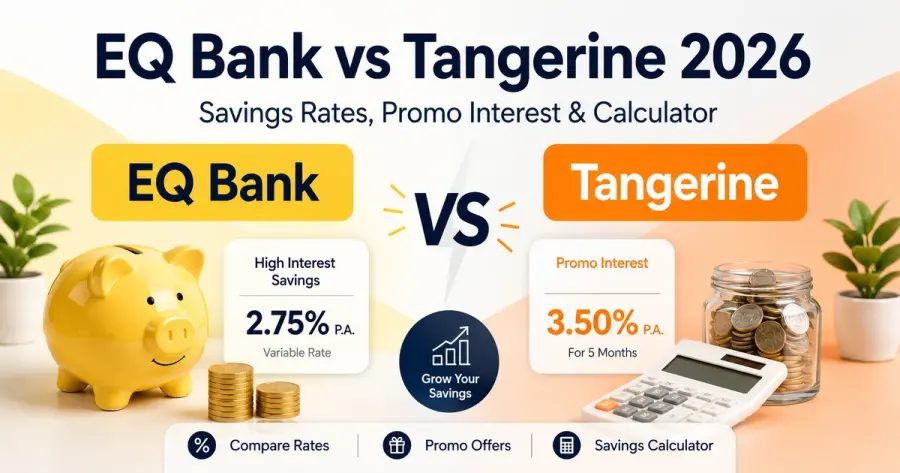
EQ Bank and Tangerine are particularly useful to compare because their offers illustrate different pricing structures. EQ Bank’s published rates effective June 11, 2026 showed a 1.00% base rate on its Personal Account and a 2.75% total rate for customers meeting its recurring direct-deposit condition, while its 30-day Notice Savings Account also showed 2.75%. Tangerine’s public new-client promotion page displayed a boosted 4.50% savings rate for up to five months when checked in August 2026, with conditions and deposit limits. The larger promotional number is attention-grabbing, but it does not answer the twelve-month question by itself.
The first rule: separate promotional interest from ongoing interest
A savings promotion is best understood as a temporary pricing period. If Tangerine pays a boosted rate for five months and then the account falls back to its regular rate, your first-year effective return depends on both phases. A comparison that multiplies the promotional rate by twelve months overstates what you would earn unless the offer actually lasts a full year. The Financial Consumer Agency of Canada specifically advises savers to understand introductory rates and make sure the account remains competitive after the introductory period ends.
This is where the Compound Interest Calculator becomes useful. Instead of running one twelve-month calculation, split the year. Calculate the promotional period using the current offer, take the resulting balance, then run the remaining months using the regular rate you have verified on the provider’s live rate page. Repeat the same timeline for EQ Bank using the exact rate you qualify for—base, direct-deposit bonus, 10-day notice, 30-day notice or a registered savings rate.
EQ Bank’s rate depends on how you use the account
EQ Bank’s Personal Account is designed to combine everyday transactions with interest. Its 2026 published terms said the base rate was 1.00%, with a total 2.75% rate available when eligible customers maintained qualifying recurring direct deposits of at least $2,000 per month. That means the higher figure is not simply a universal savings rate; it depends on payroll or other qualifying direct deposits and continuing to meet the condition.
EQ also offers Notice Savings Accounts where access is deliberately less immediate. Its June 2026 rate page listed 2.35% for the 10-day notice option and 2.75% for the 30-day notice option. The trade-off is explicit: more notice can be associated with a higher rate, but the money is not instantly accessible in the same way as an everyday savings balance. This makes the notice product potentially useful for planned goals but less suitable for every emergency-fund dollar.
Tangerine promotions require a timeline and eligibility check
Tangerine frequently uses promotional savings rates to attract new clients or encourage deposits. Its 2026 offer materials described a boosted rate for a limited number of months and set eligibility rules, account types and maximum qualifying deposits. A saver should read the offer terms rather than assume that an advertisement applies to an existing client, every account, every dollar or every date.
Promotional accounts can be excellent for money with a known short-term home. For example, if you expect to hold a house deposit for four months, a strong five-month promotion may line up with the goal. If the same money is meant to remain untouched for three years, the post-promotion rate becomes much more important. The correct comparison is therefore a cash-flow calendar: deposit date, promo end date, expected withdrawal date and the rate applicable in each interval.
How to compare a five-month promotion with a year-round rate
Imagine $30,000 that will remain in cash for twelve months with no additional deposits. Suppose Account A has a five-month promotional rate and a lower regular rate afterward, while Account B offers a lower headline rate that remains available under a condition you can meet. The account with the highest opening rate may still produce the highest first-year interest—but the margin can be far smaller than the headline gap suggests.
Use monthly or daily compounding assumptions only if they match the provider’s method. Tangerine states that savings interest is calculated daily and paid monthly. EQ Bank likewise states that interest is calculated daily on the closing balance and paid monthly for relevant accounts. A calculator using monthly compounding is a reasonable approximation for planning, but exact cents will differ because institutions use daily balances, actual day counts and changes in rates during the period.
Direct-deposit bonuses have an opportunity cost
If the higher EQ Personal Account rate requires at least $2,000 per month of qualifying recurring direct deposit, ask whether redirecting your payroll affects another banking relationship. Some competing banks offer chequing-account bonuses, fee waivers, credit-card packages or mortgage benefits for salary deposits. Moving payroll solely for a savings bonus can therefore have an opportunity cost outside the savings account.
Make the comparison at household level. If moving direct deposit to EQ increases annual savings interest by $180 but causes you to lose $240 of value elsewhere, the savings rate is not the whole story. Conversely, if you already want the EQ Personal Account for no everyday banking fees and bill payments, the bonus rate may fit naturally with no extra behavioural cost. A Budget Calculator helps identify where pay arrives and which automatic transfers or bills would need to move.
Liquidity: emergency money should not be optimized like planned savings
FCAC advises that an emergency fund should be readily accessible, have low or no transaction fees, allow withdrawals without penalty and ideally earn interest. A 30-day Notice Savings Account conflicts with the “readily accessible” requirement for the portion of cash needed immediately after a job loss, urgent repair or medical travel. Higher interest does not compensate for having the wrong liquidity when an emergency occurs.
A tiered approach can be more sensible. Keep a first layer of emergency cash in an instantly accessible account, then place a second layer—money unlikely to be needed within the next month—in a notice account if the rate premium justifies the restriction. Use the Emergency Fund Calculator to estimate three to six months of essential expenses, then decide how much of that reserve truly needs same-day access.
Deposit insurance: compare the legal institution, not just the brand
Canada Deposit Insurance Corporation coverage is a central part of a bank-savings comparison. CDIC generally protects eligible deposits up to $100,000 per insured category, per member institution, including principal and interest. Savings accounts, chequing accounts and GICs can be eligible; mutual funds, stocks, bonds, ETFs and cryptocurrencies are not CDIC deposits. Coverage is free and automatic when the deposit and institution meet the rules.
EQ Bank is a trade name of Equitable Bank, which is a CDIC member. EQ’s disclosures note that deposits under EQ Bank and Equitable Bank are aggregated for CDIC purposes within the same insured category. Tangerine Bank is also a CDIC member, but savers should still use CDIC’s member and coverage tools rather than assuming protection from branding alone. If you are approaching $100,000 plus accrued interest in one category at one member, insurance structure becomes part of the allocation decision.
TFSA, RRSP and non-registered cash are not interchangeable
A high savings rate inside a TFSA can have a different after-tax value from the same rate in a non-registered savings account because ordinary savings interest is generally taxable outside a registered shelter. Tangerine offers registered savings options, and EQ Bank publishes TFSA, FHSA and RRSP cash savings products among its rates. However, registered contribution limits and withdrawal rules matter, and using scarce TFSA room for long-term cash may have an opportunity cost if that room could otherwise hold higher expected-return investments.
For short-term goals, a TFSA savings account can be useful when contribution room is available and the withdrawal/recontribution rules fit your plan. For long-horizon retirement money, compare cash returns with appropriate diversified investments using the Investment Calculator. A savings account protects nominal principal but may not match long-term inflation and retirement-growth needs.
Interest rate versus fees and transaction friction
FCAC recommends comparing not only interest rates but also monthly fees, transaction charges, minimum balances and access. Tangerine advertises no monthly fee on its standard Savings Account and no minimum balance. EQ’s Personal Account advertises zero everyday banking fees and no minimum balance, but the specific service you use may still have limits, conditions or third-party charges. Always review the current fee schedule, not just the headline rate.
A 0.25-point interest advantage on $5,000 is only about $12.50 a year before compounding and tax. A single avoidable fee can eliminate it. On $100,000, the same 0.25 point is roughly $250 a year, so the economics differ. This is another reason “best savings account” changes by balance and behaviour.
Saving toward a house, tuition or tax bill requires matching the account to the date
Not all savings money is an emergency fund. A down payment needed in nine months, university tuition due next semester or a tax payment due next spring has a known or approximate date. For dated goals, liquidity can be planned more deliberately. A notice account may work if its notice requirement ends before the payment date; a temporary promotion can be valuable if it covers most of the holding period.
Use the Savings Goal Calculator to determine the monthly contribution required for the target, then use the compound calculator to compare interest scenarios. Do not let a small rate difference distract from contribution size. If you need $40,000 in two years, increasing monthly savings by $100 can matter more than moving between two accounts whose rates differ modestly.
Example: promo chasing with $50,000
Suppose a saver places $50,000 into a promotional account for five months, then plans to move it immediately to the best available regular account. This strategy can increase first-year interest, but only if the saver actually tracks the expiry date, remains eligible, understands whether the promotion applies to all deposits, and can transfer the balance without losing interest or creating other fees.
Model the promo period separately, then assign a conservative post-promo rate rather than assuming another equally generous promotion will definitely be available. Add a scenario where you forget to switch for three months after the promotion ends. That “inertia scenario” is often more realistic and reveals the behavioural cost of a strategy that requires constant rate chasing.
Example: EQ Notice Savings versus instant access
Assume you have $25,000 for a renovation expected in six months. If the project date is flexible and you can give 30 days’ notice before withdrawing, a Notice Savings Account may fit. Compare the published notice rate with an instant-access alternative for exactly six months. The dollar premium may be worthwhile if the restriction does not interfere with the project.
Now apply the same product to a $25,000 emergency reserve. The calculation may still show higher interest, but the use case is wrong because the money may be required tomorrow. This illustrates an important principle: maximizing yield is secondary to matching liquidity to purpose. The best account is the one that delivers the required access first and the best reasonable return second.
Rate-change risk should be part of every comparison
Both banks state that savings rates are subject to change. The Bank of Canada’s July 2026 policy rate of 2.25% also demonstrates why current deposit rates should not be treated as permanent. If policy rates, funding needs or competitive strategy change, banks can reprice variable savings products. A calculator should therefore use current rates for near-term estimates and multiple scenarios for longer periods.
For a three-year cash goal, test a current-rate scenario, a lower-rate scenario and perhaps a modestly higher-rate scenario rather than one fixed APY. For a GIC, the rate may be locked for the term, but liquidity and early-access rules differ. Comparing variable savings with a GIC is therefore a rate-and-flexibility decision, not just a percentage contest.
What to verify immediately before opening or moving money
Confirm the live rate, effective date, whether it is base or promotional, eligibility, qualifying deposit rules, promotional end date, maximum balance, minimum or direct-deposit requirement, interest-calculation method, withdrawal limitations, transaction fees, provincial availability and whether the exact product is CDIC eligible. For registered accounts, verify contribution room and tax rules separately with the Canada Revenue Agency or a qualified professional.
For Tangerine, read the specific offer terms because new-client and registered-account promotions can differ. For EQ Bank, verify whether you qualify for the Personal Account bonus rate or are comparing a notice account with different access. Saving decisions are reversible more easily than many investments, but moving cash repeatedly can still create administrative risk, missed payments or accidental loss of promotional eligibility.
Bottom line: compare the interest you will actually earn
EQ Bank versus Tangerine does not have one permanent winner. Tangerine may be especially compelling when a strong promotion matches the exact period you need; EQ may be compelling when an ongoing account structure, direct-deposit bonus or notice option fits your routine. The best outcome depends on how long the money stays, what happens after the promotion, how quickly you need access, tax registration and deposit-insurance structure.
Use the embedded compound-interest calculator to build a timeline rather than extrapolating one advertised rate across an entire year. Then confirm the live terms directly with the financial institution. This article is educational information, not financial, tax or investment advice, and advertised rates or promotions can change without notice.
Use the Compound Interest Calculator for EQ Bank vs Tangerine
Sources / Official references
- Bank of Canada — Policy interest rate
- Bank of Canada — July 2026 policy deliberations
- Financial Consumer Agency of Canada — Savings accounts
- Financial Consumer Agency of Canada — Choosing a financial institution
- CDIC — What deposits are covered
- EQ Bank — Current rates
- EQ Bank — Personal Account
- Tangerine — Savings account rates
- Tangerine — New savings account promotional offer