 Wael.T
 Compare Betterment and Wealthfront in 2026 by advisory fees, small-account pricing, tax-loss harvesting, direct indexing, advisor access, IRA features, cash…
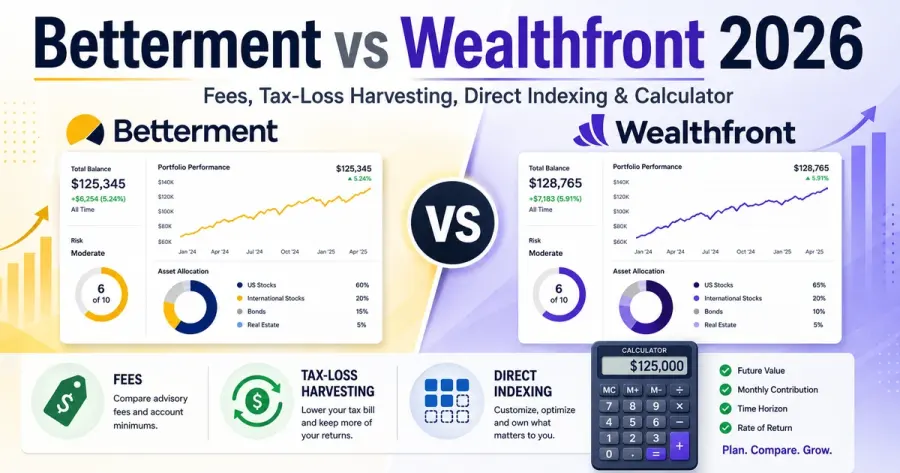
Betterment and Wealthfront are still two of the most recognizable automated investing platforms in the United States, and both headline a 0.25% annual advisory fee for their core automated portfolios. But the pricing is not actually identical for small balances, and the platforms diverge sharply once an investor reaches $100,000. Betterment emphasizes goal-based planning, tax coordination and optional access to CFP professionals; Wealthfront emphasizes software-driven investing, automated tax-loss harvesting and U.S. Direct Indexing at higher taxable balances. The better choice depends on account size, tax situation and whether you want human advice.
Why Betterment versus Wealthfront remains a high-intent 2026 search
Robo-advisors appeal to investors who want a diversified portfolio without selecting and rebalancing ETFs manually. The core promise is not market-beating stock picking. It is automated asset allocation, deposits, rebalancing, dividend handling and tax-aware portfolio maintenance. That makes the comparison commercially important for a beginner deciding where to place the first $5,000 and for a high-income household deciding where to place a six-figure taxable account.
Both firms are registered investment advisers and both use low-cost securities inside managed portfolios. Both also advertise automated tax-loss harvesting for taxable clients. Because the headline 0.25% fee looks the same, the real comparison shifts to fee thresholds, portfolio architecture, tax features, direct indexing, financial-planner access, account minimums, transfer policies and how much value the investor actually receives from automation.
The first surprise: Betterment is not always 0.25% for a small account
Betterment's 2026 pricing uses two paths for its Digital investing service. If the eligible household investing balance is below $24,000 and recurring deposits total less than $200 per month, the base charge is $5 per month. If the investor reaches $24,000 or sets recurring deposits of at least $200 monthly, pricing moves to 0.25% annually. This creates a very different effective fee for a small, inactive balance.
A $5,000 account paying $5 each month incurs $60 a year, equivalent to 1.2% of the balance before ETF expense ratios. A $5,000 account contributing $200 monthly can instead qualify for 0.25%, or roughly $12.50 on the opening balance before daily-balance changes. The recurring-deposit rule therefore matters more than the advertised percentage for many beginners.
Wealthfront uses a simpler 0.25% structure for Automated Investing
Wealthfront's current Form ADV and pricing page list a 0.25% annual advisory fee for its Automated Investing Account, calculated on account value and charged monthly. Wealthfront's support materials state a $500 minimum for its standard automated investment account. That makes Wealthfront's fee structure easier to model for a small investor who does not want to commit to a $200 recurring monthly deposit.
For $5,000, a 0.25% advisory fee is approximately $12.50 per year before fund expenses. For $20,000 it is around $50. For $100,000 it is about $250. The percentage scales linearly until other features or account structures change the economics.
Use the Investment Calculator to compare the fee drag over decades
A difference of 0.95 percentage point between 1.20% and 0.25% on a small static account can matter greatly if it persists. Enter the same starting balance and assumed pre-fee return in the Investment CalculatorROI Calculator, then reduce the return by the relevant advisory and fund costs. The purpose is not to forecast the market but to isolate a controllable expense.
Once Betterment qualifies for 0.25%, the core fee difference largely disappears. At that point the platform decision should not be based on a few dollars of management fee. The investor should compare tax functionality, portfolio preferences, access to advice, migration costs and whether the automation solves a real problem.
ETF expense ratios sit underneath both advisory fees
The 0.25% charge is not the only investment cost. ETFs used in automated portfolios have their own expense ratios, deducted inside the fund. Betterment explicitly states that fund-level fees are additional to its management charge and that it does not receive those fund fees. Wealthfront also uses ETFs and other securities whose embedded expenses remain part of the portfolio.
The correct total-cost comparison is therefore advisory fee plus weighted fund expenses plus any other strategy-specific costs. Comparing a 0.25% robo fee with a DIY brokerage at 0% while ignoring ETF expenses is incomplete because the DIY investor also pays the ETF's expense ratio. The true incremental cost of the robo-advisor is mainly the advisory layer and any implementation differences.
Betterment's strongest differentiator is its advice ladder
Betterment's standard Digital service is automated, but the company also offers Premium for clients with at least $100,000 in eligible investments. Premium currently charges 0.65% annually on eligible balances under $1 million and includes access to a team of CFP professionals. Above $1 million, Betterment applies lower advisory rates to portions of the balance under its published tiering.
This makes Betterment attractive to an investor who wants automation most of the time but values the ability to discuss retirement, equity compensation, tax planning or competing financial goals with a credentialed human team. A client who never uses the advisory access should not pay 0.65% simply because Premium sounds more complete.
Wealthfront's strongest differentiator at $100,000 is U.S. Direct Indexing
Wealthfront's integrated U.S. Direct Indexing becomes available in eligible taxable Automated Investing Accounts at $100,000. Instead of representing U.S. stocks only through a broad ETF, the strategy can hold a collection of individual large- and mid-cap stocks plus completion exposure. Wealthfront says the approach is designed to track the broad market while creating more individual positions that may generate tax-loss harvesting opportunities.
The feature is included within the 0.25% Automated Investing advisory fee. At $500,000, eligible accounts may transition to Smart Beta under Wealthfront's framework. Direct indexing is not automatically superior to a broad ETF; it introduces more tax lots, more operational complexity and potentially different tracking behaviour. Its primary attraction is tax management in taxable accounts.
Tax-loss harvesting is valuable only when the investor can actually use the losses
Both platforms market automated tax-loss harvesting, but a harvested loss is not a free return. It is a tax asset whose value depends on the investor's capital gains, ordinary income, tax bracket, holding period and future tax rate. U.S. tax rules generally allow capital losses to offset capital gains and, subject to limits, a portion of ordinary income, with unused losses carried forward.
An investor in a high tax bracket with a large taxable portfolio and recurring gains may value harvesting more than a student with no taxable gains and most assets inside a Roth IRA. Tax-loss harvesting is generally irrelevant inside tax-advantaged retirement accounts because gains and losses are not recognized in the same way.
Wash-sale risk increases when investments are spread across multiple brokers
A robo-advisor can control trades inside the accounts it manages but may not know about substantially identical purchases made in an outside brokerage or a spouse's account. That matters because the U.S. wash-sale rule can defer a loss when the same or substantially identical security is purchased within the relevant window. Betterment specifically warns that scattered investments can reduce the suitability of its TLH feature.
If you use Betterment for taxable investing but automatically buy the same ETFs in an external IRA, the system may not fully prevent every cross-account wash sale. Wealthfront faces the same broad household-level limitation. Consolidation or careful coordination can be more important than which tax algorithm sounds more sophisticated.
Historical SEC actions are relevant due diligence, not a prediction of future performance
The SEC charged Wealthfront in 2018 over disclosures and compliance failures that included statements about monitoring for wash sales in its tax-loss harvesting service. The SEC later charged Betterment in 2023 over misstatements and omissions concerning its TLH service, contract notices, records and software-related issues affecting certain clients. Both matters were settled under the terms described by the SEC.
These are historical regulatory events and should not be presented as evidence that today's services will fail. They are useful because they illustrate a broader robo-advisor lesson: tax automation is software, not magic. Investors should read current disclosures, understand limitations and avoid treating estimated tax benefits as guaranteed returns.
Betterment Tax Coordination can matter for households with multiple account types
Betterment's tax-aware architecture includes Tax Coordination, which seeks to locate different asset classes across taxable and tax-advantaged accounts when the investor has eligible accounts within the Betterment ecosystem. The concept is to place tax-inefficient assets where tax treatment may be more favourable while maintaining the household's overall target allocation.
Asset location can create value beyond simple tax-loss harvesting, but only if the investor has the right combination of account types and keeps enough of the portfolio within the platform for the system to coordinate. An investor with only a Roth IRA gains much less from this feature than a household with taxable, traditional IRA and Roth assets.
Wealthfront's software-first philosophy may appeal to investors who do not want advisor meetings
Wealthfront positions its core experience around automation and financial planning software rather than recurring human-advisor access. Its Path-style planning tools connect goals and accounts, and the managed portfolio can rebalance automatically. Investors who prefer to make strategic decisions independently may value this lower-touch model.
A person who becomes anxious during market downturns may prefer the option to speak with a human financial professional. Another person may consider meetings unnecessary and prefer a fully software-driven process. That preference is behavioural, but behaviour can determine whether an investor stays invested.
Example: a $5,000 beginner who contributes only $50 per month
At Betterment, this investor would not meet the $200 recurring-deposit threshold and would remain below $24,000, so the $5 monthly fee structure could apply. Sixty dollars a year on a $5,000 opening balance is substantial relative to Wealthfront's 0.25% structure. The gap narrows as the balance grows, but it can persist for years with slow contributions.
If the same investor can responsibly automate $200 per month, Betterment can move to the 0.25% pricing path and the cost comparison changes immediately. Never increase contributions merely to avoid a platform fee if doing so would strain the household budget. The investment plan must serve the cash flow, not the fee schedule.
Example: a $25,000 retirement account
At $25,000, Betterment qualifies for the 0.25% annual price based on balance, and Wealthfront's core fee is also 0.25%. If the account is an IRA, taxable tax-loss harvesting is not the main differentiator. The investor should compare portfolio construction, goal tools, supported IRA features, transfer experience and personal preference for the interface.
At this balance the annual advisory fee is roughly $62.50 before fund expenses on either platform. A DIY investor could potentially save the advisory layer, but must be willing to choose an allocation, rebalance, reinvest and stay disciplined without automated guidance.
Example: a $100,000 taxable account
This is the most interesting threshold. Betterment's standard Digital service remains 0.25%, while Premium becomes available at 0.65% if human CFP access is desired. Wealthfront remains 0.25% and eligible taxable Automated Investing accounts can gain U.S. Direct Indexing. The investor is choosing between different forms of value rather than different base fees.
A high-income professional with large realized capital gains may place high value on direct indexing and tax-loss harvesting. A household with complicated retirement, insurance and equity-compensation questions may value Betterment Premium's human advice more. Neither feature should be selected without estimating whether it will actually be used.
Example: a $500,000 household with taxable and retirement assets
At half a million dollars, a 0.25% advisory fee is about $1,250 annually before fund expenses. Betterment Premium at 0.65% would be about $3,250 on a comparable eligible balance, a difference around $2,000 a year. The advice must therefore provide meaningful value to justify the premium tier.
Wealthfront's higher-balance taxable features can become more sophisticated, including Smart Beta eligibility under its rules. Betterment can coordinate tax location across eligible accounts. At this scale, the decision should be based on an after-tax household model rather than a generic ranking.
Direct indexing can create a large number of positions
One practical issue appears when a client eventually leaves a direct-indexing strategy. A portfolio with many individual stocks may be less portable or more tax-complex than a portfolio holding a few ETFs. Selling everything to simplify can realize capital gains, while transferring in kind can leave the investor with many tax lots to manage.
Before enabling direct indexing, consider the exit as well as the entry. The benefit during accumulation should be large enough to justify potential future complexity. This is particularly important for an investor who expects to move assets to a human adviser later.
Betterment's $75 outbound transfer fee should enter a migration decision
Betterment's current fee information states a $75 fee for each investing account transferred to another company. A household with several account registrations could therefore face multiple transfer charges. Wealthfront's current transfer procedures and any receiving-firm reimbursement should also be checked before moving.
Transfer fees are usually small compared with a six-figure balance, but tax consequences can be much larger if securities must be sold. Ask whether holdings can transfer in kind and how proprietary or fractional positions will be handled before initiating a migration.
Cash products should not be used to rank the investment portfolios blindly
Both companies offer cash-management products separate from the core investment account. Betterment Cash Reserve and Wealthfront Cash Account use partner-bank structures and variable yields. Those yields can change quickly with Federal Reserve policy and competitive pricing. A temporary cash APY advantage does not automatically make the associated investment service better.
Keep emergency cash, near-term goals and long-term investments conceptually separate. Compare cash on yield, insurance structure, access and limits; compare investment accounts on portfolio, tax, fees and behaviour. One brand does not need to win every financial category.
SIPC protection does not protect against market losses
Brokerage custody associated with robo-advisors can be covered by SIPC subject to its rules, typically up to $500,000 including a $250,000 limit for cash claims when a member brokerage fails and customer assets are missing. SIPC is not insurance against stocks or ETFs losing value.
A diversified portfolio can still decline 30% or more in a severe bear market. That is investment risk and remains with the client. Do not interpret brokerage protection as a guarantee of account value.
DIY investing is the real third competitor
For disciplined investors, the relevant comparison may be Betterment versus Wealthfront versus a low-cost self-directed brokerage holding one or two diversified ETFs. The DIY route can remove the 0.25% advisory layer, but the investor assumes responsibility for allocation, rebalancing, tax management and behaviour.
On $500,000, 0.25% is $1,250 annually. That is meaningful. But a single panic sale during a bear market can cost much more. The right question is whether automation and tax management improve the investor's real-world decisions enough to justify the fee.
What to verify before opening either account
Confirm the current advisory fee, account minimum, small-balance pricing, ETF expenses, tax-loss-harvesting eligibility, direct-indexing threshold, Premium requirements, supported account types, transfer-out costs and current disclosures. If you have outside accounts, understand how wash-sale monitoring and asset-location features interact with assets the robo-advisor cannot see.
Also decide whether the account is taxable or tax-advantaged before ranking tax features. A feature that may be valuable in a taxable brokerage can be irrelevant in a Roth IRA.
Bottom line: Wealthfront is often cheaper for a small inactive balance; Betterment offers a stronger human-advice path
For a small account below $24,000 without $200 monthly recurring deposits, Wealthfront's 0.25% pricing can be materially cheaper than Betterment's $5 monthly structure. Once Betterment qualifies for 0.25%, the core fees converge. At $100,000, the comparison becomes more strategic: Wealthfront adds integrated U.S. Direct Indexing for eligible taxable accounts, while Betterment offers Premium human advice at a higher price and a broader tax-coordination approach.
Run the Investment Calculator below with your actual balance, contribution rate, fee and horizon. Then decide whether you need tax automation, direct indexing, human planning or simply a disciplined low-cost portfolio. This article is general educational information and not personalized investment or tax advice.
Compare Betterment and Wealthfront fee drag with the Investment Calculator
Sources / Official references
- Betterment — Pricing and investing fees
- Betterment — Detailed fee schedule
- Betterment — Tax-loss harvesting disclosure
- Betterment — Tax-loss harvesting methodology
- Wealthfront — Pricing
- Wealthfront — Form ADV client brochure, May 2026
- Wealthfront — US Direct Indexing
- Wealthfront — Tax-Loss Harvesting
- SEC — Betterment tax-loss harvesting enforcement action
- SEC — Wealthfront robo-adviser enforcement action
- SIPC — Investor protection