 Wael.T
 A detailed UK ISA guide for 2026/27 covering the £20,000 allowance, Cash ISA vs Stocks & Shares ISA, flexible withdrawals, Lifetime ISA, FSCS protection and…
Updated: 26 August 2026
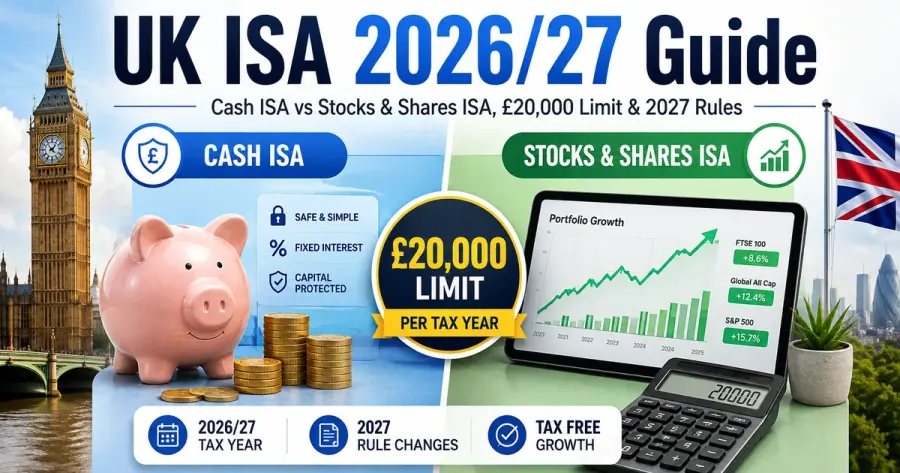
The UK ISA rules are unusually important in 2026 because savers are dealing with two different policy periods at once. For the current 2026/27 tax year, the overall ISA subscription allowance is still £20,000. From 6 April 2027, the government plans to cap new Cash ISA subscriptions at £12,000 for people under 65, while keeping the overall ISA allowance at £20,000; people aged 65 or over will retain a £20,000 Cash ISA limit. The right response is not to rush from cash into investments. It is to decide what each part of your money is for, how soon you may need it, and which tax wrapper best matches that job.
1. The current 2026/27 ISA rule is still £20,000 overall
For the tax year running from 6 April 2026 to 5 April 2027, an adult can subscribe up to £20,000 across eligible ISAs. That £20,000 is a combined annual limit, not £20,000 for every ISA type. You might put all of it into a Cash ISA, all of it into a Stocks & Shares ISA, or split it between different ISA types, subject to the rules of each product. The policy change announced for April 2027 does not reduce the current 2026/27 overall allowance. If you are planning contributions this tax year, use the rules that apply now rather than behaving as though next year’s restrictions have already started.
2. From April 2027, the Cash ISA limit changes for people under 65
HMRC’s 2026 reform documents say that from 6 April 2027, investors under age 65 will be able to put up to £12,000 of new annual subscriptions into Cash ISAs, while the overall ISA allowance remains £20,000. Someone aged 65 or over keeps a £20,000 Cash ISA limit. In practical terms, an under-65 saver who wants to use the full £20,000 annual ISA allowance from 2027/28 will need to place at least £8,000 outside a Cash ISA, for example in a Stocks & Shares ISA or another eligible non-cash ISA. That does not mean the government is guaranteeing that investing the extra £8,000 will be suitable for every household.
3. Cash ISA and Stocks & Shares ISA solve different problems
A Cash ISA is primarily a tax-free savings wrapper. Its return comes from interest and the capital value does not normally move with stock markets. A Stocks & Shares ISA is an investment wrapper: you can hold funds, ETFs, shares, bonds and other permitted investments, and the value can rise or fall. Comparing the two only by the interest rate or expected return misses the most important distinction. Cash is designed for certainty and near-term access; investments are designed for money that can tolerate volatility. A six-month emergency reserve should not be exposed to a 30% equity drawdown merely because the tax wrapper is available.
4. Use a time-horizon test before deciding how much cash to keep
Divide your money by when it may be spent. Funds required within roughly one to three years for a house deposit, tuition bill, tax payment or planned move generally need much more stability than retirement money with a 20-year horizon. Use the Savings Goal Calculator to give each goal a date and a target amount. A saver with £20,000 available today may discover that £12,000 is genuinely short-term and £8,000 is long-term. In that case, the future 2027 Cash ISA ceiling would happen to align with the plan. Another saver may need the entire £20,000 for a house purchase next year and should not manufacture investment risk just to use every penny of the ISA allowance.
5. Emergency funds belong in the liquidity conversation, not the return race
Before increasing investment exposure, calculate how much cash you would need if income stopped or a large bill arrived. The Emergency Fund Calculator can help estimate a reserve based on essential expenses and household circumstances. A household with one variable income, children and a mortgage may need more cash than two secure earners with low fixed costs. The ISA decision should follow that need. If your emergency fund is £15,000, the fact that the future under-65 Cash ISA subscription limit is £12,000 does not mean your safe reserve should fall to £12,000; money can also be held in ordinary protected savings accounts.
6. Ordinary savings accounts still matter because of the Personal Savings Allowance
For 2026/27, the Personal Savings Allowance remains £1,000 of savings income for basic-rate taxpayers and £500 for higher-rate taxpayers; additional-rate taxpayers do not receive the allowance. This means some savers can earn a meaningful amount of bank interest outside an ISA before tax becomes payable. The value of a Cash ISA therefore depends partly on your tax band, interest income and how much cash you hold. A basic-rate taxpayer with modest savings may have little immediate tax to save, while a higher-rate taxpayer with a large cash balance can reach the allowance quickly. Tax-free does not automatically mean highest net return if a taxable account pays a materially better rate.
7. Savings tax becomes more important from April 2027
The government has announced higher tax rates on savings income from 2027/28: 22% at the savings basic rate, 42% at the higher rate and 47% at the additional rate, while the Personal Savings Allowance is due to remain. That makes sheltering interest potentially more valuable for savers whose taxable savings income exceeds their allowance. The policy creates an interesting tension: the Cash ISA subscription limit for under-65s will fall to £12,000 at the same time the marginal tax rate on savings income rises. This is another reason to compare net returns across Cash ISA, ordinary savings and suitable investments instead of focusing on only one headline policy.
8. FSCS protection on eligible UK deposits is now £120,000 per authorised firm
Since 1 December 2025, eligible deposits at PRA-authorised UK banks, building societies and credit unions are generally protected by the Financial Services Compensation Scheme up to £120,000 per person, per authorised firm. Cash ISAs are included within that deposit protection where the deposit is eligible. The limit applies by authorised institution, not necessarily by brand, because one banking group can operate several brands under the same authorisation. Large cash savers should therefore check the legal institution behind the account. This protection relates to bank failure; it is different from investment-market risk in a Stocks & Shares ISA, where the value of assets can fall even when the platform itself remains financially healthy.
9. A Stocks & Shares ISA should be built around diversification, not the new Cash ISA rule
Moving money into investments only because a Cash ISA limit falls is a poor investment thesis. If you invest, choose an asset mix that fits your horizon and ability to tolerate losses. A diversified global equity fund can spread exposure across many companies and countries, while a narrow technology or thematic ETF can be much more concentrated. Bonds can reduce some portfolio volatility but also carry interest-rate and credit risks. Use the Investment Calculator to compare several long-term return assumptions, such as 3%, 5% and 7%, rather than building a retirement plan around one optimistic market forecast.
10. Investment fees deserve as much attention as tax sheltering
An ISA protects eligible investment returns from UK income tax and capital gains tax inside the wrapper, but the platform and funds can still charge fees. A platform fee of 0.25%, a fund cost of 0.20% and dealing charges are economically different from a low-cost all-in service at 0.20%. Over 20 or 30 years, small annual differences compound. The Compound Interest Calculator can model the same gross return with different annual costs. The correct comparison is not merely “tax-free versus taxable”; it is net return after product charges, taxes outside wrappers and the risk taken to earn that return.
11. Flexible ISAs can preserve allowance after withdrawals, but only if the provider offers flexibility
GOV.UK explains that a flexible ISA can let you withdraw cash and replace it in the same tax year without the replacement using additional annual allowance. Flexibility is optional, so you must check the provider’s terms. For example, if you subscribe £10,000 during 2026/27 and withdraw £3,000, a flexible ISA may allow you to put back that £3,000 plus use the remaining £10,000 allowance. In a non-flexible ISA, the withdrawal does not restore allowance. This feature can be useful for cash management, but it should not be confused with penalty-free access: a fixed-rate Cash ISA can still impose product-specific withdrawal charges even if the wrapper itself permits withdrawal.
12. Use the official ISA transfer process instead of withdrawing and redepositing casually
When moving an ISA from one provider to another, ask the new provider to arrange an ISA transfer. Simply withdrawing the money to your bank account and paying it into a different ISA can turn the transaction into a new subscription and use annual allowance, unless specific flexible-ISA replacement rules apply. The distinction matters especially for large balances built over many tax years. Under the announced 2027 reforms, transfers from non-cash ISAs into Cash ISAs will be restricted for people under 65, while Cash ISA to non-cash ISA transfers remain possible. That makes transfer planning more important as the new regime approaches.
13. The 2027 rules also target cash held inside non-cash ISAs
HMRC’s anti-circumvention factsheet says that from April 2027, interest paid on cash held within a non-Cash ISA will be subject to a 22% charge. Money market funds are the category identified as “cash-like” assets for the reform, with specific restrictions designed to stop a Stocks & Shares ISA being used as a substitute Cash ISA. Ordinary shares, funds, ETFs, investment trusts, corporate bonds and government bonds are not automatically treated as cash-like merely because they are held in a non-cash ISA. Investors should follow the final regulations and provider implementation, because the reform is detailed and account mechanics can vary.
14. Lifetime ISA can be more valuable than a normal ISA for an eligible first-home goal
A Lifetime ISA has a separate £4,000 annual payment limit that counts toward the overall £20,000 ISA allowance. Eligible people must make their first Lifetime ISA payment before age 40, can contribute until age 50 and can receive a 25% government bonus, up to £1,000 a year. It can be used for a qualifying first home or later life, subject to the scheme’s withdrawal rules. For an eligible first-time buyer, the government bonus can be more important than squeezing every pound into a Cash ISA. Use the Down Payment Calculator to estimate the deposit target before deciding how much of the ISA allowance belongs in a Lifetime ISA versus other savings.
15. Do not ignore the Lifetime ISA withdrawal charge
The attractive 25% bonus comes with restrictions. Withdrawals for purposes outside the permitted first-home or later-life rules can face a 25% withdrawal charge, subject to the statutory exceptions. Because the charge is applied to the amount withdrawn after the bonus has been added, it can remove the bonus and part of the saver’s original money. That makes the Lifetime ISA inappropriate for an emergency reserve. A first-time buyer should keep separate accessible cash for conveyancing surprises, moving costs and post-purchase repairs rather than assuming every pound of the deposit fund can sit behind a restricted wrapper.
16. Example: a 32-year-old with £20,000 and a house purchase in 18 months
Suppose a first-time buyer has £20,000 available, expects to buy within 18 months and is eligible for a Lifetime ISA. The dominant risk is not missing stock-market growth; it is losing part of the deposit before completion. A sensible analysis could allocate qualifying Lifetime ISA contributions for the bonus, hold the rest in competitive cash savings or Cash ISA depending on tax position, and avoid high-equity exposure for the deposit. The exact split depends on existing LISA history and purchase eligibility. The Home Affordability Calculator can show whether the deposit is actually the limiting factor or whether income and mortgage affordability matter more.
17. Example: a 45-year-old investing for retirement over 20 years
A 45-year-old with a complete emergency fund and no near-term use for the annual savings has a different problem. For that person, holding the entire £20,000 ISA allowance in cash every year can create substantial long-term opportunity cost if inflation exceeds cash returns over time. A diversified Stocks & Shares ISA may be appropriate for part or most of the long-term allocation, depending on risk tolerance and pension assets. Use the Retirement Calculator to estimate the income gap first, then decide how much investment risk is necessary rather than investing simply because the Cash ISA limit is changing.
18. Example: a saver aged 67
Someone aged 67 is treated differently under the announced April 2027 Cash ISA reform because the £20,000 Cash ISA subscription limit is retained for people aged 65 and over. That does not automatically mean an older saver should hold 100% cash. A 67-year-old may still have a 20- or 30-year investment horizon for part of the portfolio, while needing a larger cash reserve for spending and near-term withdrawals. The correct allocation should reflect pension income, planned withdrawals, health contingencies and estate goals. The age-based policy gives more cash flexibility; it does not replace portfolio planning.
19. Avoid the end-of-tax-year rush
ISA allowance is annual, so unused allowance generally cannot be carried forward after the tax year closes. That creates a familiar March-and-early-April rush. Rushing can lead people to place long-term money into an unsuitable fund, accept a poor Cash ISA rate or misunderstand transfer rules. A better process starts months earlier: estimate the amount available to save, complete the emergency reserve, decide which portion is short-term and which is long-term, and compare providers before the deadline. If you cannot use the full allowance without weakening your financial resilience, leaving some allowance unused can be more sensible than forcing a bad decision.
20. A practical 2026/27 ISA decision order
First, identify money needed within three years and protect it from unnecessary market risk. Second, calculate an emergency fund and keep it accessible. Third, check whether a Lifetime ISA is relevant for a qualifying first-home or later-life objective. Fourth, estimate how much interest you may earn outside wrappers and whether the Personal Savings Allowance already covers it. Fifth, invest only the genuinely long-term surplus in a diversified portfolio with costs you understand. Finally, prepare for the April 2027 Cash ISA reform, but do not let a future subscription rule push present-day cash into investments that do not fit your horizon.
Bottom line
The most important ISA decision in 2026 is not “Cash ISA or Stocks & Shares ISA?” in isolation. It is how to assign different jobs to your money. The current 2026/27 overall allowance is £20,000. The planned 2027 reform reduces new Cash ISA subscriptions to £12,000 for under-65s while retaining the £20,000 overall ISA limit and the £20,000 Cash ISA limit for people aged 65 or over. Use tax wrappers where they add value, but let liquidity, risk, horizon and costs determine the asset choice. This guide is general educational information, not personalised investment, tax or financial advice.
Official and authoritative sources
- GOV.UK — Individual Savings Accounts overview
- HMRC — ISA reform 2027 anti-circumvention rules factsheet
- HMRC — Individual Savings Account (Amendment) Regulations 2026 consultation
- GOV.UK — ISA withdrawals and flexible ISAs
- GOV.UK — Lifetime ISA overview
- GOV.UK — 2026/27 tax rates and Personal Savings Allowance
- GOV.UK — Savings-income tax changes from April 2027
- Bank of England — FSCS deposit protection up to £120,000