 Wael.T
 Compare outdoor and garage home-battery locations using product ratings, temperature limits, service clearances, and California permitting guidance.
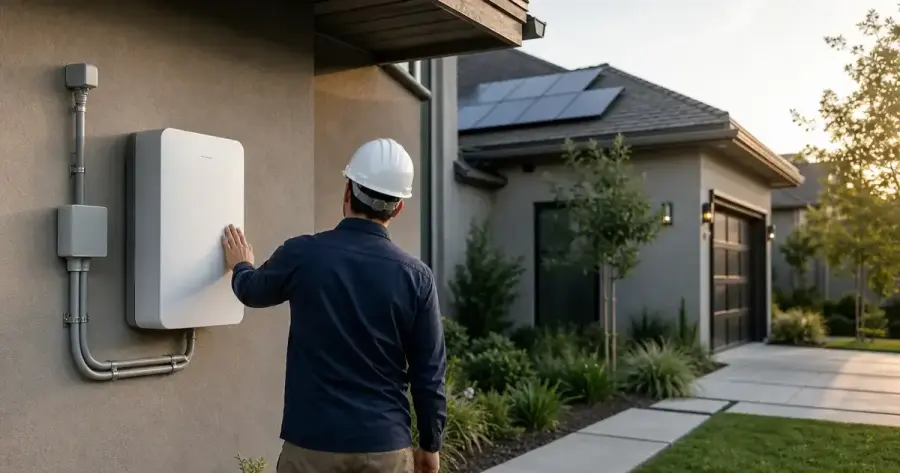
Yes—an outdoor home-battery installation can be appropriate, but only when the exact battery is rated for outdoor use and the proposed location meets the manufacturer’s instructions and local permit requirements. There is no single U.S.-wide exterior-wall clearance that applies to every battery. The product listing, installation manual, applicable local rules, and permitting authority determine whether an exterior wall or garage location is acceptable.
Begin with the exact battery model
Do not rely on a generic claim that a “solar battery” can go outside. Confirm the proposed model’s environmental rating, operating-temperature range, mounting options, vent locations, required clearances, and the location requirements for related equipment.
Tesla Powerwall 3 is one model-specific example. Its published specifications identify it as indoor- and outdoor-rated, with a NEMA 3R enclosure rating and an operating range of –4°F to 122°F (–20°C to 50°C). Tesla also states that performance may be derated above 104°F (40°C), even though the unit remains within its stated operating range. These figures apply to Powerwall 3—not automatically to another brand or model. Review the Tesla Powerwall 3 specifications for outdoor rating and temperature limits before using it as a comparison point.
Heat and cold: an operating range is not a full-power guarantee
A published temperature range tells you the conditions in which a product is designed to operate; it does not necessarily promise maximum charging or discharge power at every temperature in that range. Tesla’s Powerwall 3 specifications expressly note possible high-temperature derating above 104°F.
Temperature planning should also account for the battery’s internal conditions rather than treating outdoor air temperature as the only input. Enphase’s North American guidance explains that internal and external temperatures differ and that charge or discharge power can be limited outside preferred conditions. See Enphase’s temperature guidelines for IQ Battery installation for that model-family example.
For an exposed wall, ask the installer to assess direct sun, surrounding surfaces, enclosure ventilation, and the site’s expected hot and cold conditions against the exact battery manual. Do not assume that a garage will always be cooler or that an outdoor-rated battery will always deliver its rated power outdoors.
Clearances, airflow, and service access
Exterior walls are not unlimited installation space. Landscaping, gates, storage, and other equipment can obstruct vents or prevent service access after the installation is complete. The applicable product instructions set the required dimensions.
For example, Tesla’s Powerwall 3 location guidance requires clear space for airflow, cabling, and service. It specifies 4 inches at each side, 2 inches above, 0.8 inches below, and 12 inches in front for airflow; it also calls for 36 inches in front for access and working space under its NEC-based guidance, subject to any larger local requirement. The same guidance says rear and lower-front vents must remain free of obstructions and debris, and it prohibits horizontal or upside-down mounting. Use the Powerwall 3 clearance and airflow requirements only for a Powerwall 3 design.
For an indoor Powerwall 3 installation, Tesla also specifies a minimum room size of 5.25 by 5.25 by 8 feet, or an equivalent room volume, under its cited UL 9540 and UL 9540A criteria. That indoor room-volume condition does not replace the model’s outdoor clearance requirements.
California provides a useful—but not nationwide—code example
California’s Energy Storage Permitting Guidebook, updated January 21, 2026, addresses behind-the-meter systems and provides residential siting guidance for one- and two-family dwellings and qualifying townhomes. It states that residential energy-storage systems must be listed and labeled to UL 9540 and installed in accordance with the manufacturer’s instructions.
For a California exterior installation, the guidebook lists outdoor or exterior-side-of-wall placement no less than 3 feet from doors and windows that directly enter the dwelling unit. It also notes that a smaller separation can be allowed when the UL 9540 listing and manufacturer’s installation instructions permit it. That California example should not be presented as a nationwide 3-foot rule. Read the California Energy Storage Permitting Guidebook’s residential ESS siting guidance and confirm the local requirement before selecting a wall.
Exterior wall versus attached garage
An exterior wall may be a good choice when:
- The exact battery is rated for outdoor installation.
- The proposed location preserves every required clearance and keeps vents unobstructed.
- For California projects, the wall location meets the applicable separation from dwelling-entry doors and windows, unless the product listing and manual allow otherwise.
- The installer can use an approved mounting arrangement and provide access for installation and service.
An attached garage may be a better choice when:
- The selected manual permits indoor or garage installation and the required room, access, and working-space conditions can be maintained.
- The exterior location would expose the equipment to conditions that conflict with the product’s temperature-performance guidance.
- The garage location can remain clear of stored items that would obstruct access or airflow.
Neither option is automatically superior. The correct choice is the one that complies with the specific product instructions and the approved site plan.
Questions to resolve before accepting an installation quote
- Is the exact battery model listed and rated for the proposed indoor or outdoor location?
- What are its published operating-temperature limits, and when can temperature-related power derating occur?
- Which required clearances apply to the battery, disconnects, gateways, and other associated equipment?
- Will vents and service space remain clear after landscaping, storage, or future changes to the property?
- What siting, separation, and permit conditions does the local authority require?
- Does the proposed wall-mount or floor-mount arrangement match the manufacturer’s approved installation method?
For broader system planning, estimate likely solar output with the Solar Power Calculator and review voltage, current, and power relationships with the Watts, Volts & Amps Calculator. For array-sizing context, see whether a 10 kW solar system may suit a California house. These resources do not replace product instructions or permit review.
Bottom line
An outdoor home battery can be a sound option, but an outdoor rating alone is not enough. Verify the exact model’s temperature behavior, airflow and service clearances, approved mounting method, and local siting rules. For California homeowners, exterior separation from dwelling-entry doors and windows is a specific issue to check. Elsewhere in the United States, do not substitute California’s numbers or Tesla’s model-specific dimensions for the requirements that govern your installation.
Limitations: This article is planning information, not an installation design or a code determination. Final placement should be based on the exact equipment documentation, site conditions, permit review, and direction from the local authority having jurisdiction.